
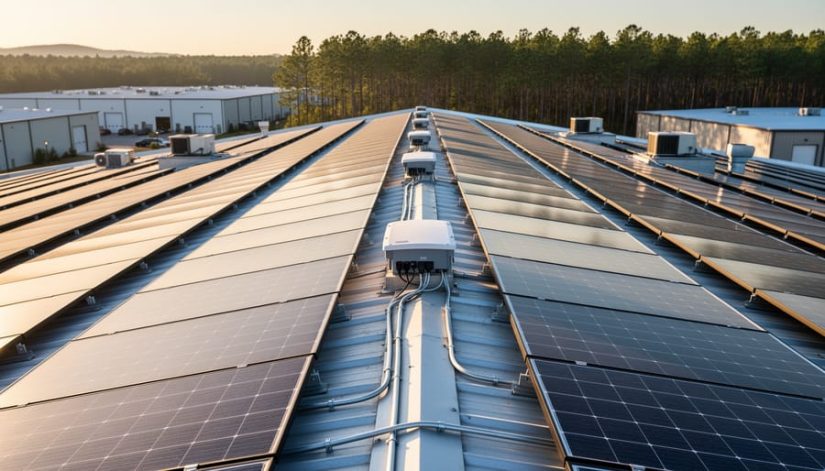
What Your Commercial Solar Installation Will Actually Cost in 2024
Commercial solar installations typically cost between $2.00 and $3.50 per watt before incentives, meaning a 100-kilowatt system for a medium-sized business runs $200,000 to $350,000. That number drops significantly when you factor in the federal Investment Tax Credit, which reduces costs by 30%, plus accelerated depreciation benefits that can lower your net investment by another 20-30% in the first year alone.
Understanding these costs requires looking beyond equipment prices. Your total investment includes solar panels and inverters, certainly, but also engineering design, permitting fees, electrical upgrades, mounting systems, labor installation, and ongoing monitoring equipment. In North Carolina, site-specific factors like roof condition, electrical panel capacity, and shading analysis directly impact your bottom line. A warehouse with a newer metal roof costs considerably less to outfit than an older building requiring structural reinforcement.
The real question isn’t just what you’ll pay upfront, but what you’ll save over 25-30 years. Most North Carolina businesses see positive cash flow within 5-8 years, with many installations paying for themselves entirely through reduced electricity bills. Commercial electricity rates in our state average 10-11 cents per kilowatt-hour, and those rates historically increase 2-3% annually. Locking in your energy costs today means predictable expenses tomorrow.
This comprehensive breakdown walks you through actual cost components, North Carolina-specific incentives, financing options that require zero money down, and realistic ROI calculations based on your business type. You’ll see exactly where your money goes and when you’ll start seeing returns.
Understanding the Base Investment: Equipment and Hardware Costs
Solar Panels: The Heart of Your System
Commercial solar panels represent your largest equipment investment, typically accounting for 30-40% of your total system cost. Pricing varies significantly based on efficiency ratings and manufacturing origin. Standard panels might cost $0.50-$0.75 per watt, while premium high-efficiency models range from $0.85-$1.25 per watt.
Here’s what drives these differences: Higher efficiency panels produce more electricity in less space, which matters when roof area is limited. American-made panels often cost 10-15% more upfront compared to imported alternatives, but this premium brings real advantages for North Carolina businesses.
We prioritize American-made products because they typically include 25-30 year performance warranties versus 10-15 years for some imports. You’ll also benefit from faster warranty service and better customer support when working with domestic manufacturers. Local manufacturing means replacement parts arrive quickly if needed, minimizing downtime.
When evaluating panel costs, consider the complete picture: a slightly higher investment in quality panels with robust warranties protects your system’s performance for decades. Think of it as choosing between basic and premium equipment for your business—the upfront difference pays dividends in reliability and long-term energy production.
Inverters and Balance of System Components
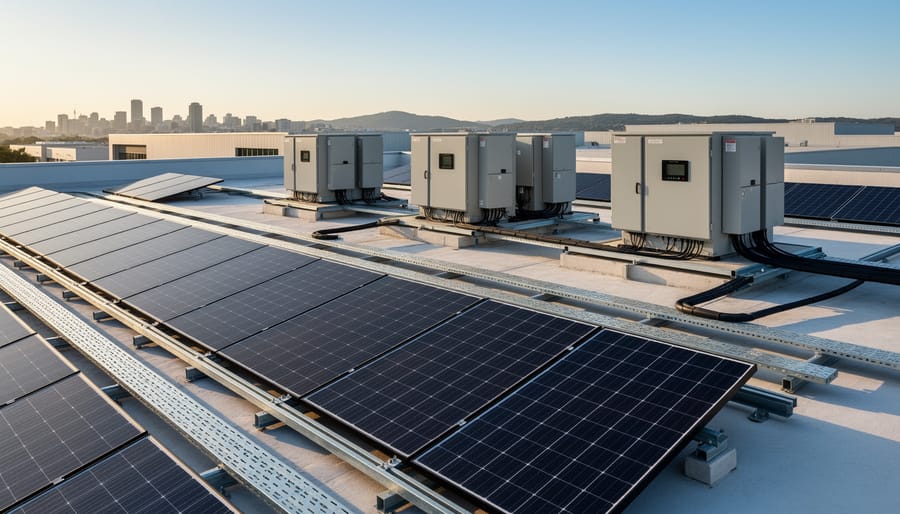
Beyond the solar panels themselves, your commercial system needs critical components to convert and manage electricity safely. The inverter stands as the hardest-working piece of equipment, transforming the direct current (DC) from your panels into alternating current (AC) that powers your business operations.
For commercial installations, you’ll typically encounter three inverter types. String inverters offer the most cost-effective solution for straightforward roof layouts, generally running $0.10-$0.15 per watt of your system capacity. Microinverters attach to individual panels and work well for complex roof designs with shading issues, though they cost more at $0.25-$0.35 per watt. Central inverters serve large-scale installations exceeding 100 kW and provide excellent value for ground-mounted arrays.
Your balance of system components include electrical panels, disconnect switches, monitoring equipment, and protective conduit. These essential items typically add $0.15-$0.25 per watt to your project. Many North Carolina businesses appreciate that quality American-made inverters and electrical components, while sometimes carrying a modest premium, often deliver superior warranties and local service support. A 100 kW system might allocate $20,000-$30,000 for inverters and balance of system hardware combined, representing roughly 15-20% of total equipment costs.
Mounting and Racking Systems
The mounting and racking systems needed for your commercial solar installation significantly impact overall costs, typically representing 10-15% of your total project expense. Your building’s roof type matters—flat commercial roofs generally require ballasted racking systems that don’t penetrate the roof membrane, while sloped metal roofs often allow for less expensive attachment methods. The structural integrity of your building also plays a crucial role. Older buildings may need reinforcement to support solar panel weight, adding $2,000-$10,000 to your project depending on the scope of work required.
Ground-mount systems present an alternative worth considering if your roof isn’t suitable or if you have available land. While ground mounts typically cost 10-20% more due to foundation work and additional materials, they offer easier maintenance access and optimal panel positioning. Many North Carolina businesses with larger properties find this investment worthwhile for long-term performance. Your installer will conduct a structural assessment to determine the most cost-effective mounting solution for your specific situation, ensuring your system is both secure and economically viable.
Installation Labor and Soft Costs: The Hidden Price Factors
Professional Installation Labor
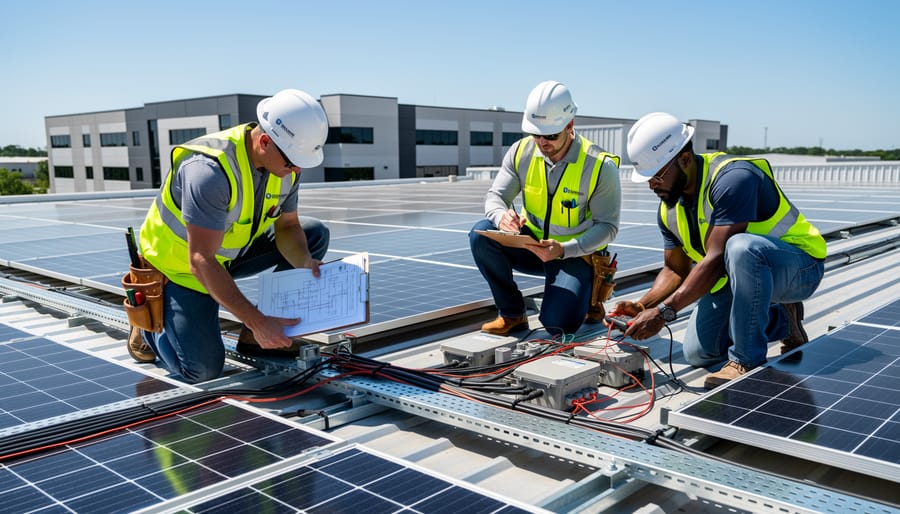
Professional installation labor typically represents 10-15% of your total commercial solar project cost, but this investment ensures safety, performance, and longevity. In North Carolina, commercial installations require licensed electricians who understand local building codes and interconnection requirements with utility companies.
Your installation team should include certified professionals with credentials from organizations like the North American Board of Certified Energy Practitioners (NABCEP). These certifications demonstrate expertise in proper system design, electrical connections, and safety protocols. For commercial projects, experience matters significantly—crews familiar with large-scale installations work more efficiently and anticipate potential challenges before they become costly problems.
The solar installation process for commercial buildings involves structural assessments, electrical upgrades, and careful coordination with your business operations to minimize disruption. Experienced installers understand how to work around your schedule, ensuring minimal downtime while maintaining quality standards.
Quality installation crews also handle permit applications, utility interconnection paperwork, and final inspections—services included in labor costs. While it might be tempting to choose the lowest bid, remember that proper installation directly impacts your system’s 25-30 year performance and your warranty coverage. American-made systems paired with skilled local installers provide reliability and accessible support throughout your solar investment’s lifetime.
Engineering, Permitting, and Inspections
Before your commercial solar system generates its first kilowatt-hour, several behind-the-scenes professionals need to approve and verify your installation. These engineering, permitting, and inspection costs typically add $5,000 to $15,000 to your project, but they’re essential for safety and legal operation.
Structural engineering assessments verify your roof or ground mount can safely support solar panels for decades. In North Carolina, where we experience everything from hurricane-force winds to winter ice, this step isn’t just bureaucratic—it protects your investment and property. Engineers evaluate load capacity, ensuring your building can handle the additional weight and wind stress.
Electrical design work ensures your system integrates properly with your existing electrical infrastructure and meets all safety codes. This becomes particularly important for larger commercial installations where power requirements are complex.
Local permitting fees vary significantly across North Carolina municipalities. Expect to pay anywhere from $500 to $3,000 depending on your location and system size. Charlotte and Raleigh typically have more streamlined processes, while smaller counties may require additional documentation.
The utility interconnection process allows your system to connect to the grid, enabling you to send excess power back and receive credits. Duke Energy and other North Carolina utilities have specific requirements and associated fees, usually ranging from $500 to $2,000.
Finally, plan for inspection costs. Local building departments and electrical inspectors must sign off on your installation before you can flip the switch. While some municipalities include this in permit fees, others charge separately. Working with experienced installers familiar with North Carolina regulations helps streamline this entire process, potentially saving you time and money.
System Size and Your Building’s Unique Requirements
How System Size Affects Per-Watt Pricing
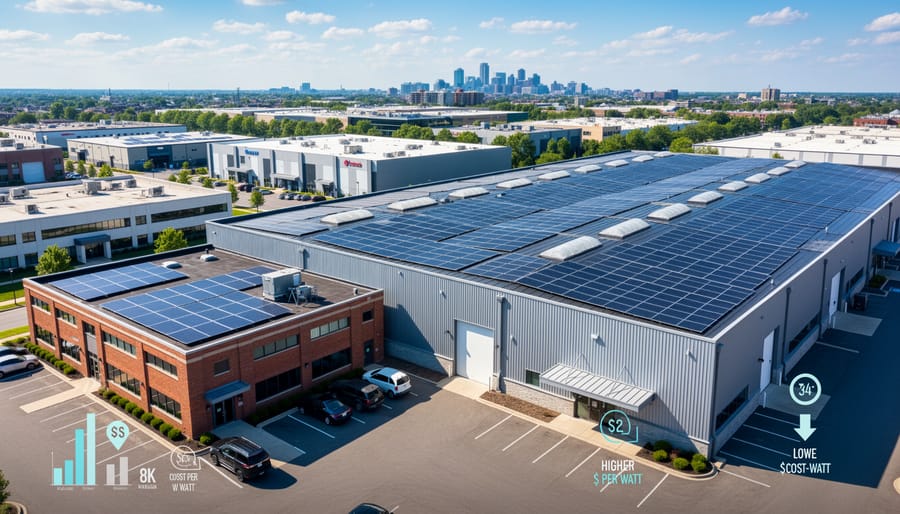
One of the most encouraging aspects of commercial solar is that larger systems typically cost less per watt. This happens because many installation expenses—like permitting, design work, and site preparation—remain relatively fixed whether you’re installing a small or large system. When you spread these costs across more panels, your per-watt price drops significantly.
For a small business installing a 25kW system, you might see costs around $3.00 to $3.50 per watt before incentives. That translates to roughly $75,000 to $87,500 for the complete installation. Medium-sized businesses installing 100kW systems often enjoy better pricing, typically $2.50 to $3.00 per watt, or $250,000 to $300,000 total. Large commercial installations of 500kW or more can achieve even more favorable rates, often between $2.00 to $2.50 per watt, meaning a 500kW system might cost $1,000,000 to $1,250,000.
These economies of scale make solar particularly attractive for growing businesses. You’re not just investing in clean energy—you’re benefiting from efficiency that comes with size. Keep in mind that North Carolina’s business-friendly incentives apply regardless of system size, so even smaller installations remain financially viable and environmentally responsible choices for your company.
Building-Specific Cost Variables
Your building’s current condition plays a significant role in determining your final installation costs. Let’s look at the key factors that can affect your project budget.
The age and condition of your roof is perhaps the most critical consideration. If your roof needs replacement or major repairs within the next 10-15 years, it makes financial sense to address this before installing solar panels. Otherwise, you’ll face the added expense of removing and reinstalling the entire solar array when roof work becomes necessary. A roof in good condition requires no additional investment, while repairs or replacement can add $5,000 to $50,000 or more to your project, depending on your building’s size.
Your electrical panel’s capacity must be sufficient to handle the solar system integration. Older commercial buildings may require panel upgrades or replacements, typically costing between $2,000 and $8,000. This ensures your system operates safely and efficiently.
Some buildings require structural reinforcement to support the additional weight of solar panels, especially older structures or those with unique roof designs. Engineering assessments and reinforcements can add $3,000 to $15,000 to your costs.
Finally, accessibility matters. Buildings with difficult roof access, multiple levels, or complex layouts increase labor time and equipment needs. Ground-mounted systems, while avoiding some roof-related concerns, require adequate land space and may need additional permitting.
Real Numbers: What North Carolina Businesses Actually Pay
Let’s talk real numbers. In North Carolina, commercial solar installations typically range from $2.50 to $3.50 per watt before any incentives are applied. These figures reflect the complete installation, including equipment, labor, permits, and all the essentials to get your system online and producing clean energy.
To help you understand what this means for your business, here’s what actual projects look like across different scales:
| System Size | Total Cost Range (Pre-Incentive) | Monthly Production | Typical Business Type |
|---|---|---|---|
| 25 kW | $62,500 – $87,500 | 2,700 – 3,100 kWh | Small retail, offices |
| 50 kW | $125,000 – $175,000 | 5,400 – 6,200 kWh | Restaurants, warehouses |
| 100 kW | $250,000 – $350,000 | 10,800 – 12,400 kWh | Manufacturing, large retail |
| 250 kW | $625,000 – $875,000 | 27,000 – 31,000 kWh | Industrial facilities, campuses |
These are baseline costs, and here’s something important to remember: larger systems generally benefit from economies of scale, bringing your per-watt cost toward the lower end of that range. A 250-kilowatt installation often costs considerably less per watt than a 25-kilowatt system because equipment, labor, and administrative costs spread across more panels.
Your specific location within North Carolina can also influence pricing. Urban installations in Charlotte or Raleigh might differ slightly from rural areas due to labor availability and permitting processes. Building characteristics matter too. A straightforward rooftop installation typically costs less than a ground-mount system requiring additional structural work.
It’s worth emphasizing that these figures represent your investment before applying federal tax credits, state incentives, and utility rebates. The actual amount your business pays will be significantly lower once you factor in available programs, which we’ll explore in detail. Many North Carolina businesses find their net investment drops by 40 percent or more after incentives.
Federal Tax Credits and Incentives That Lower Your Bottom Line
The 30% Federal Investment Tax Credit
The federal tax credit, officially known as the Investment Tax Credit (ITC), provides a significant financial boost for commercial solar projects. Currently set at 30% through 2032, this incentive allows businesses to deduct nearly a third of their total solar installation costs directly from their federal taxes.
Here’s what makes this opportunity so valuable: the credit applies to the complete system cost, including solar panels, inverters, mounting equipment, labor, permitting fees, and other installation expenses. If your commercial solar system costs $100,000, you’ll receive a $30,000 tax credit that reduces what you owe the IRS dollar-for-dollar.
To qualify, your business must own the solar system (leased systems don’t qualify for the business owner) and have enough tax liability to use the credit. The good news is that if you can’t use the full credit in one year, you can carry it forward to future tax years.
Claiming the federal solar tax credit requires filing IRS Form 3468 with your business tax return. We recommend working with a tax professional familiar with solar incentives to ensure you capture the full benefit and comply with all requirements.
MACRS Depreciation Benefits
Beyond the Investment Tax Credit, commercial solar systems qualify for five-year MACRS depreciation, which provides substantial additional tax savings. MACRS stands for Modified Accelerated Cost Recovery System, and it allows your business to recover the cost of solar equipment through accelerated depreciation deductions over five years rather than the typical 27.5-year schedule for commercial property.
Here’s how it works: After claiming the 30% federal tax credit, you can depreciate 85% of your system’s cost (the IRS requires you to reduce the depreciable basis by half of your ITC percentage). For a $100,000 system, you’d depreciate $85,000 using an accelerated schedule that front-loads the deductions. The first year alone typically delivers about 20% depreciation, with substantial deductions continuing through year five.
For North Carolina businesses, this means significant cash flow benefits during the early years of ownership. A company in the 21% federal tax bracket could see approximately $17,850 in additional tax savings from MACRS depreciation. When combined with the ITC, these incentives dramatically reduce your net investment and accelerate your payback period, making solar even more financially attractive for commercial operations.
State and Local Incentives in North Carolina
North Carolina businesses can significantly reduce solar installation costs through state-specific programs. The state offers a corporate income tax credit that allows commercial properties to claim a percentage of their solar investment. Many North Carolina utilities provide additional rebates and performance-based incentives for commercial installations, though these vary by service territory. Duke Energy and other local providers sometimes offer interconnection benefits that streamline your system’s connection to the grid. Municipal governments in cities like Charlotte and Raleigh occasionally run pilot programs supporting commercial renewable energy projects. These local incentives stack with federal tax credits, potentially covering up to 60% of your total installation costs. We recommend consulting with a local installer familiar with current North Carolina programs to maximize your savings, as these incentives change regularly and some operate on first-come, first-served funding.
Financing Options That Make Solar Accessible Today
Understanding your payment options is just as important as understanding the technology itself. The good news? You don’t need hundreds of thousands of dollars sitting in your bank account to start generating solar power for your business. Today’s financing landscape offers several pathways that make commercial solar accessible regardless of your company’s cash position.
Cash purchase remains the most straightforward option. When you buy your system outright, you own it immediately, qualify for all available tax incentives, and see the highest long-term returns. However, this approach requires significant upfront capital—typically $75,000 to $500,000 depending on system size—which isn’t feasible for every North Carolina business.
Solar loans function similarly to equipment financing you might already use for vehicles or machinery. You own the system and claim all incentives while spreading payments over 5 to 20 years. Many lenders now offer commercial solar-specific products with competitive rates, making ownership accessible without depleting operating capital.
Power Purchase Agreements, or PPAs, flip the model entirely. A third-party company installs and owns the solar system on your property at no upfront cost to you. You simply purchase the electricity it generates at a predetermined rate, typically lower than your current utility rate. This approach eliminates maintenance responsibilities and provides immediate savings without capital investment.
Solar leases are similar to PPAs but involve paying a fixed monthly amount for the equipment rather than paying per kilowatt-hour produced. You gain predictable costs and reduced electricity bills without ownership responsibilities.
- Cash purchase delivers maximum ROI and full incentive capture with no interest costs.
- Solar loans provide ownership benefits while preserving working capital for operations.
- PPAs require zero upfront investment and transfer all maintenance responsibilities to providers.
- Leases offer predictable monthly costs without performance risk.
- Cash purchase ties up significant capital that could support other business priorities.
- Solar loans add debt obligations and interest costs that reduce overall returns.
- PPAs mean you don’t own the system or claim tax benefits on your property.
- Leases provide smaller savings since payments continue regardless of production levels.
The right choice depends on your business’s financial position, tax situation, and long-term property plans. Many North Carolina businesses find that solar loans offer the best balance—securing ownership and incentives while maintaining cash flow flexibility for daily operations and growth opportunities.
Long-Term Savings and Return on Investment
Understanding the financial timeline of your commercial solar investment helps you make confident decisions about moving forward. Most North Carolina businesses see their solar systems pay for themselves within 5-8 years, depending on system size, energy usage, and available incentives.
The payback period calculation is straightforward: divide your net system cost (after incentives and tax credits) by your annual electricity savings. For example, if your business invests $75,000 after incentives and saves $12,000 yearly on electricity, your payback period is approximately 6.25 years. After that point, your savings become pure profit, and commercial solar panels typically produce energy for 25-30 years.
When evaluating return on investment, consider multiple financial benefits beyond monthly utility savings. Commercial solar systems increase property value, with studies showing buildings equipped with solar commanding higher sale prices and rental rates. You’ll also gain protection against rising electricity costs—while utility rates typically increase 2-4% annually, your solar production cost remains stable.
North Carolina’s net metering policies strengthen your ROI further by crediting you for excess energy your system sends back to the grid. During peak production hours, you’re essentially banking energy credits for later use, maximizing the value of every kilowatt-hour produced.
Many businesses achieve 15-20% annual returns on their solar investment when factoring in all benefits, making commercial solar one of the most reliable investments available. Additionally, American-made solar equipment often comes with stronger warranties and performance guarantees, protecting your investment long-term. Your solar system becomes a revenue-generating asset that continues delivering value decades after installation, while supporting your business’s commitment to sustainability and energy independence.
Getting an Accurate Quote for Your Business
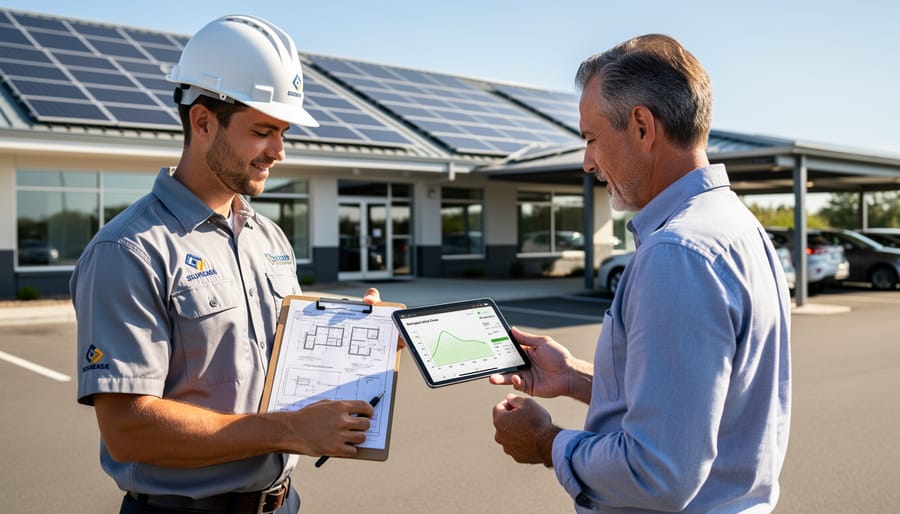
Getting accurate quotes for your commercial solar installation starts with being prepared. Before reaching out to installers, gather essential information about your business: your current monthly and annual electricity usage (found on your utility bills), your facility’s roof condition and age, available ground space if considering ground-mounted systems, and your business’s typical operating hours. This information helps installers provide realistic estimates tailored to your specific energy needs.
During the consultation process, expect a thorough site assessment. Reputable installers will visit your property to evaluate roof structure, shading issues, electrical panel capacity, and optimal panel placement. They should ask detailed questions about your energy goals and explain how system size affects both upfront costs and long-term savings. Be wary of installers who provide quotes without conducting an on-site evaluation or who pressure you into immediate decisions.
Watch for red flags that signal potential problems. Quotes that seem significantly lower than competitors may indicate inferior equipment or hidden costs. Avoid installers who aren’t transparent about warranties, maintenance requirements, or post-installation support. Check that they’re properly licensed, insured, and experienced with commercial projects in North Carolina.
Ask these crucial questions to ensure accurate pricing: What specific equipment brands are included? Does the quote cover all permits, interconnection fees, and installation labor? How do you calculate expected energy production? What warranties are provided on equipment and workmanship? Can you provide references from similar commercial installations? Understanding these details helps you compare quotes effectively and makes choosing the right installer much easier. Request multiple quotes and don’t hesitate to ask for clarification on any line items you don’t understand.
Investing in commercial solar installation represents a significant upfront commitment, but the long-term financial returns and environmental benefits make it one of the smartest decisions your North Carolina business can make. While costs may seem substantial initially, the combination of federal tax credits, state incentives, accelerated depreciation, and decades of reduced energy expenses dramatically improve your return on investment. Most businesses find that solar systems pay for themselves within seven to ten years, then continue generating free electricity for 25 years or more.
The key to maximizing your investment lies in partnering with experienced local installers who understand North Carolina’s unique climate conditions, utility requirements, and incentive programs. Working with professionals who prioritize American-made solar products ensures you’re getting durable, high-quality equipment backed by strong warranties and domestic support. These aren’t just purchasing decisions—they’re investments in reliable performance and long-term value for your business.
Every commercial property has unique energy needs, roof characteristics, and financial considerations that affect solar costs and savings potential. Rather than relying on general estimates, we encourage you to take the next step with a personalized solar assessment. A detailed evaluation of your specific situation will provide accurate cost projections, realistic savings estimates, and a clear understanding of available incentives. This customized approach ensures you make an informed decision based on your business’s actual circumstances, not industry averages. Contact a trusted local solar installer today to discover how commercial solar can work for your North Carolina business.
